Embroidery as a Living Thread Through Human History
There is something quietly extraordinary about embroidery. A needle, some thread, and a piece of fabric — yet from these simple materials, cultures across every continent have woven stories, identities, spiritual beliefs, and social hierarchies into cloth. Embroidery is one of humanity’s oldest art forms, predating written language in many civilisations, and its significance has never truly diminished. If anything, in a world saturated with mass-produced goods, the value of hand-stitched work has become even more resonant.
From the elaborate goldwork adorning medieval European ecclesiastical robes to the vivid silk embroidery of Chinese imperial courts, and from the geometric needlework of Palestinian thobe dresses to the intricate mirror-work of Gujarati textiles, embroidery tells us who people are, where they come from, and what they hold sacred. This article explores the deep cultural significance of embroidery across time and geography, and why it continues to matter in contemporary art and society.
A Stitch in Time: The Ancient Origins of Embroidery
The history of embroidery stretches back thousands of years. Archaeological evidence suggests that embroidered clothing existed as far back as 30,000 BCE, with fossilised remains of hand-stitched garments discovered in Russia. In ancient Egypt, tomb paintings and preserved textiles reveal sophisticated needlework techniques, and it is worth noting that the tomb of Tutankhamun — King Tut — contained garments decorated with elaborate embroidery, demonstrating just how central textile art was to ancient Egyptian culture and ritual.
In China, silk embroidery dates back over 2,000 years, with the Han Dynasty producing some of the earliest documented examples of fine embroidered silk. Meanwhile, in ancient Phrygia (modern-day Turkey), the art form was so highly regarded that the Romans coined the term Phrygium opus — Phrygian work — to describe gold embroidery, a name that eventually evolved into the word “embroidery” itself.
These origins matter because they reveal something important: embroidery was never merely decorative. From its earliest instances, it carried meaning — marking status, communicating religious devotion, and encoding cultural information into garments worn by the living and the dead alike.
Why Is Embroidery an Important Art Form?
Embroidery occupies a unique position in the spectrum of artistic expression. Unlike painting or sculpture, it is tactile, wearable, and often functional — yet it demands the same level of skill, creativity, and intention as any fine art medium. There are several reasons why embroidery is considered such a vital art form across cultures.
It Preserves Cultural Identity
Perhaps the most profound function of embroidery is its role as a keeper of cultural identity. In many communities, specific stitching patterns, colour combinations, and motifs carry coded information — indicating a woman’s village of origin, her marital status, her tribe, or her social standing. In Palestinian tradition, for example, the embroidered thobe (a long dress) features regional patterns that are so distinct that scholars and community members can identify a woman’s home village simply by examining her needlework. This practice, known as tatreez, was inscribed on UNESCO’s list of Intangible Cultural Heritage in 2021, acknowledging its irreplaceable cultural value.
It Functions as a Form of Communication
Before widespread literacy, embroidery served as a visual language. In medieval Europe, the Bayeux Tapestry — technically an embroidery rather than a woven tapestry — functioned as a narrative document, depicting the Norman conquest of England in 1066 across nearly 70 metres of linen. It remains one of the most remarkable examples of embroidery as storytelling in history.
Similarly, in 19th-century America, quilting and embroidery bees served as communal spaces where women exchanged news, opinions, and emotional support through the language of needlework. Stitched samplers were used to teach young girls not only needlework skills but also literacy, moral values, and domestic virtues — embedding educational purpose into textile art.
It Reflects Spiritual and Religious Belief
Embroidery has deep roots in religious practice across virtually every faith tradition. In Christianity, elaborate embroidered vestments, altar cloths, and church banners have been central to worship for over a millennium. What does the Bible say about embroidery? Several passages reference fine needlework directly. Exodus 28:39, for instance, describes the garments of the Israelite priests as featuring “embroidered work,” indicating that embroidery was considered appropriate — even sacred — adornment for those performing holy duties. Psalm 45:14 describes a royal bride being brought to the king in “embroidered garments,” further linking the craft to ceremony and elevated status.
In Islamic tradition, embroidery decorates Qur’anic manuscripts and textiles used in mosques, while in Hinduism, richly embroidered garments are worn during festivals and religious ceremonies. Buddhist temple hangings across Asia feature intricate embroidered imagery as objects of devotion. Across all of these traditions, the time and skill invested in embroidered religious objects is itself understood as an act of reverence.
Which City Is Called the City of Embroidery?
The title of “City of Embroidery” is most commonly attributed to Madeira, the Portuguese archipelago off the coast of northwest Africa, which has been famous for its exquisite whitework embroidery since the 19th century. Madeira embroidery — characterised by delicate, intricate patterns worked in white thread on white linen or cotton — gained international recognition when British merchants began exporting it to Europe and North America, and it remains a protected geographical indication product today.
However, other cities lay strong claims to the title. Lucknow, in the Indian state of Uttar Pradesh, is celebrated as the home of chikankari, a delicate style of shadow embroidery with origins in the Mughal court. The city’s entire cultural identity is bound up with this craft, and it continues to sustain a vast network of artisans. Rabat in Morocco is similarly renowned for its traditional rabati embroidery, and Suzhou in China — one of the four great embroidery centres of the country — produces silk embroidery so fine it can be viewed from both sides simultaneously, with different images visible on each face of the cloth.
The Four Famous Embroideries of China
China has one of the richest embroidery traditions in the world, and the four famous embroideries are widely regarded as the pinnacle of this heritage. They are:
- Su Embroidery (Suzhou, Jiangsu Province): Known for its fine silk thread, delicate colour gradations, and extraordinary detail. Su embroidery is famous for its double-sided work and realistic depictions of animals, particularly cats and fish.
- Xiang Embroidery (Hunan Province): Characterised by bold, vibrant colours and a distinctive use of Chinese painting principles. Xiang embroidery is known for its powerful depictions of tigers and lions.
- Yue Embroidery (Guangdong Province): One of the oldest Chinese embroidery styles, featuring rich colours, strong outlines, and elaborate decorative patterns. It has influenced embroidery traditions across Southeast Asia.
- Shu Embroidery (Sichuan Province): Distinguished by its bright colours and smooth texture, often depicting fish, insects, and flowers with remarkable lifelike quality.
Together, these four traditions represent centuries of refinement and represent a significant portion of China’s Intangible Cultural Heritage designations.
Embroidery as Resistance and Political Expression
Throughout history, embroidery has also functioned as a form of quiet — and sometimes not so quiet — resistance. During the suffragette movement in early 20th-century Britain, women stitched banners, badges, and handkerchiefs decorated with political slogans and symbols. These embroidered objects were simultaneously dismissed as “women’s work” by opponents and wielded deliberately as tools of visibility and solidarity by the movement.
In more recent decades, Chilean arpilleras — small embroidered panels — became powerful instruments of political testimony under the Pinochet dictatorship of the 1970s and 1980s. Women whose family members had been “disappeared” by the regime created these brightly coloured textile works to document human rights abuses and smuggle information about atrocities to the outside world. The arpilleras were literally contraband, sewn in secret and exported hidden in aid packages. Today they are recognised as significant historical documents as well as works of art.
Contemporary Embroidery: Between Tradition and Innovation
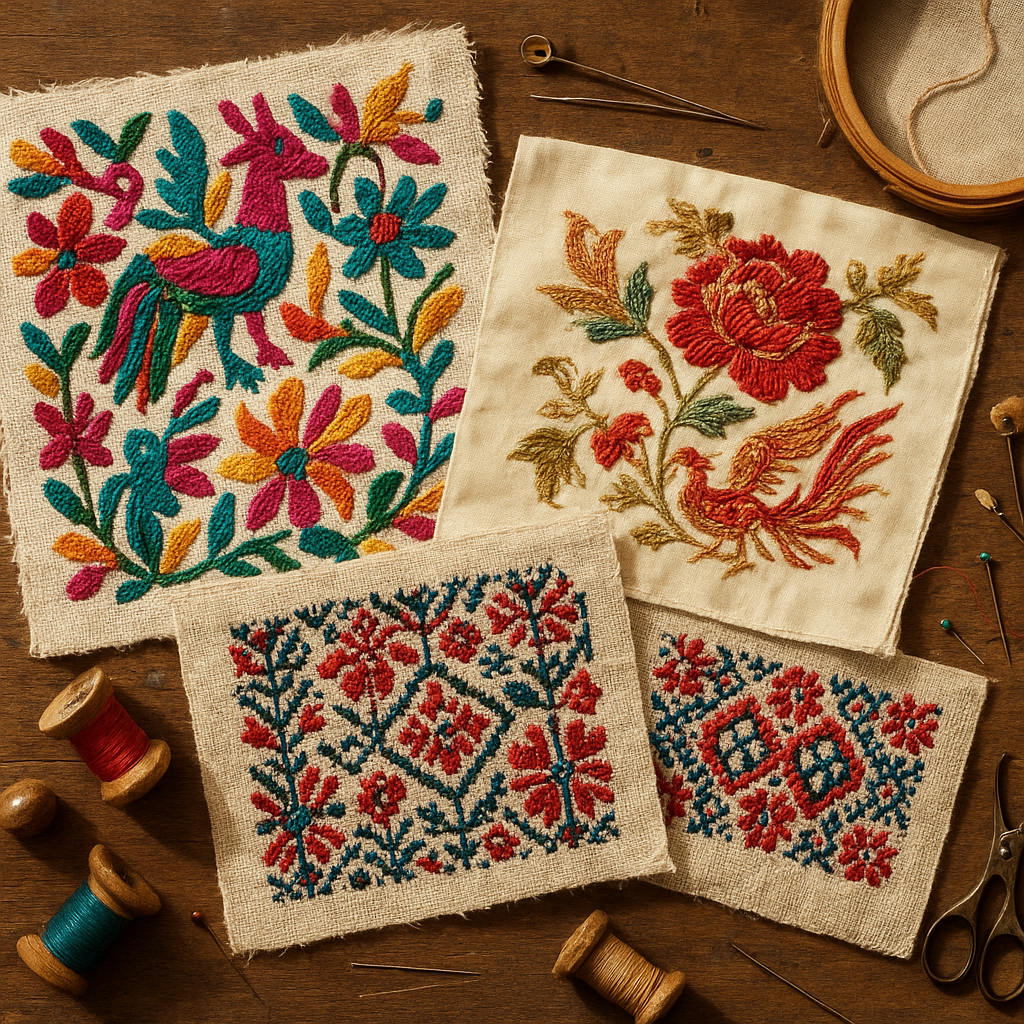
Far from being a relic of the past, embroidery is thriving in contemporary art and culture. A growing wave of artists are using embroidery as a medium for fine art, challenging the historic dismissal of textile crafts as “lesser” forms of creative expression. Artists such as Cayce Zavaglia, whose photorealistic portrait embroideries blur the boundary between needlework and painting, and Ghada Amer, who incorporates embroidery into large-scale installations exploring gender and sexuality, have helped bring the medium into serious gallery and museum contexts.
The craft revival of recent years — accelerated in part by the global pandemic, which saw a significant surge in home crafting — has also brought embroidery to a new generation of practitioners. Online communities, video tutorials, and social media platforms have democratised access to embroidery traditions from around the world, enabling enthusiasts to learn Palestinian tatreez, Japanese sashiko, or Brazilian dimensional embroidery from their own homes.
At the same time, serious concerns exist about the sustainability of traditional embroidery knowledge. Many specialised regional techniques are practised by a shrinking number of skilled artisans, and the economic pressures of globalisation and machine reproduction threaten their survival. UNESCO’s ongoing work to inscribe traditional embroidery practices as Intangible Cultural Heritage reflects a growing international consensus that these skills represent irreplaceable cultural knowledge deserving active protection.
The Social Fabric: Embroidery, Community, and Wellbeing
Beyond its cultural and artistic dimensions, embroidery has long played a role in community building and individual wellbeing. Communal sewing and embroidery circles have historically been spaces of female solidarity and mutual support across many cultures. In contemporary settings, embroidery groups and textile clubs continue to serve as meaningful social spaces, particularly for older adults and those experiencing isolation.
Research in the field of occupational therapy has highlighted the mental health benefits associated with repetitive craft activities, including reduced anxiety, improved concentration, and a sense of accomplishment. The meditative quality of needlework — the rhythmic passing of thread through fabric — has been compared to mindfulness practices, and many embroiderers describe the process as deeply calming and restorative, much like the healing potential of creative expression more broadly.
Conclusion: Why Embroidery Still Matters
Embroidery endures because it is, at its core, a deeply human activity. It is slow, deliberate, and personal in a way that machine-made textiles can never replicate. Every stitch represents a choice — of colour, direction, tension, and form — and in aggregate, those choices tell a story about the person who made them and the culture from which they came.
Its significance spans the sacred and the secular, the political and the personal, the ancient and the contemporary. It has served as a language when other forms of communication were denied, a record when official histories ignored certain lives, and a source of beauty in circumstances that might otherwise have offered very little of it. The cultural significance of embroidery lies not just in the finished objects it produces, but in the knowledge, community, and meaning embedded in the practice itself — a living tradition carried forward one stitch at a time.